
"How might we design a more up-to-date online historical archive, so that it can be used as a research platform by not only academicians but also history enthusiasts?"
About the Project
Client: Orient Analytics
Business Context: Online Historical Archive Platform (SaaS)
Operating Model: Solo Start-Up
My Role: Conversational UX Designer, Brand Concept Designer, UX Writer
Final Delivery: Web App Design, User Flows, Brand Strategy, Visual Brand Identity Document & Design Language System (DLS) Document
Methodologies & Tools
Discovery
Secondary Research: AI-Assisted Methods
Qualitative Research: User & Founder Interviews
Quantitative Research: Online Survey
Analysis & Ideation
Affinity Map, Business Objective Model Canvas, Value Proposition Canvas, User Personas, User Journeys and Painpoints, Problem Space Perspective Grid
Design
Solution State Perspective Grid, User Flow, To-Be User Journey, Design Systems, Conversational UX Design - AI Agent
Project Overview
The Backstory
Orient Analytics was built as a "digital library for history", that goes beyond academic journals to include high-resolution scans of primary documents (letters, maps, manuscripts) and 3D or photographic records of physical artifacts. The business owner was also an academician and this SaaS idea came to his mind because of the scattered situation of historical data specifically about middle eastern world.
The Challenge
The client reached out to me for a solution about his brand architecture and asked for a strategic solution for his sub-brands. He was also unsure about the ease of use of this platform; he was afraid that the platform would look like an out-dated academic library search page, and he asked for a better suggestion.
The Goal
Making an academic research tool more user friendly, fun-to-use and look modern.
The Solution
Brand Architecture: Designed a brand architecture that will cover all the sub-brands under the main brand which helped the users navigate between each, easier.
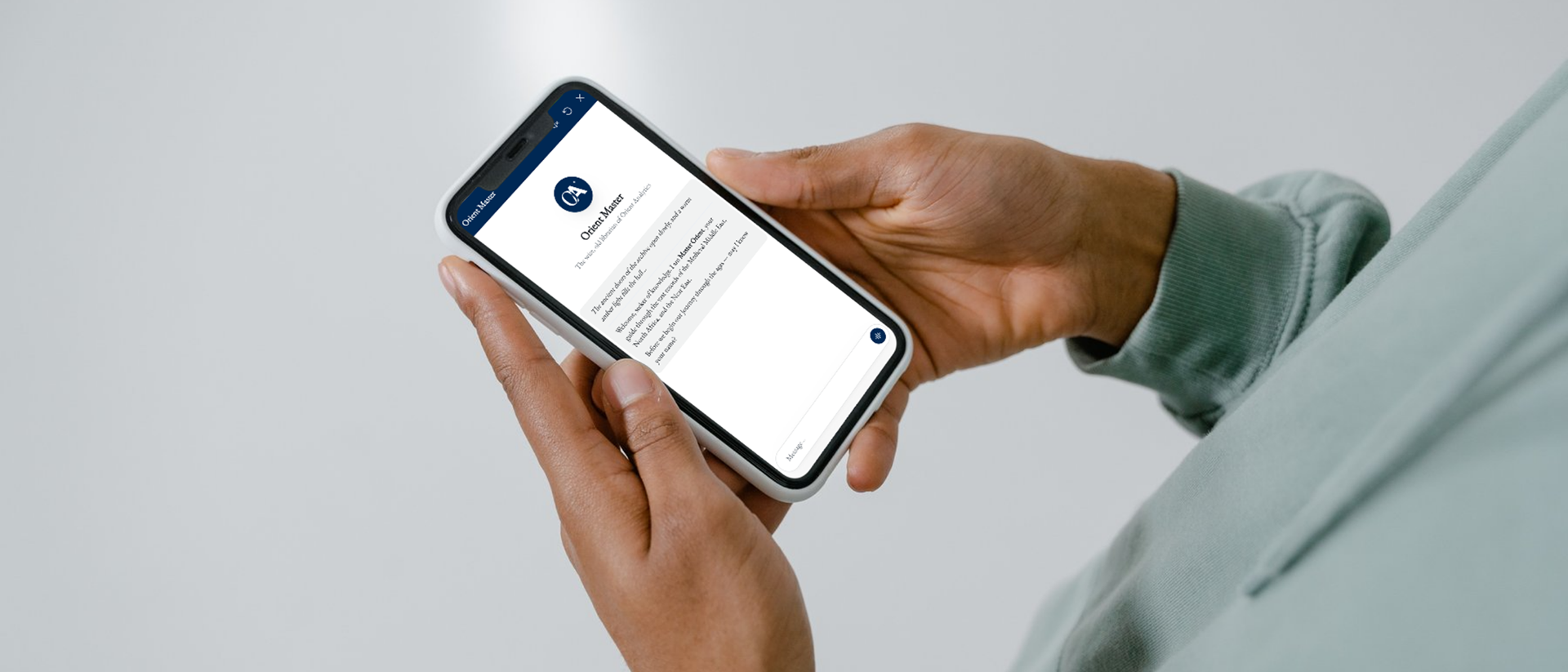
Brand Concept & Conversational UX Design: Designed an AI Agent for the platform, which would act like an old wise librarian, in harmony with the brand's identity and overall solution concept.
Visual Trust: Developed a robust Brand Strategy and Visual Identity designed to feel familiar and authoritative. The aesthetic was specifically crafted to appeal a broader range of users; both world of academicians and antiquity enthusiasts.
The "Double Diamond Design" Process Summary
1. Discovery
Understanding Archive Tools
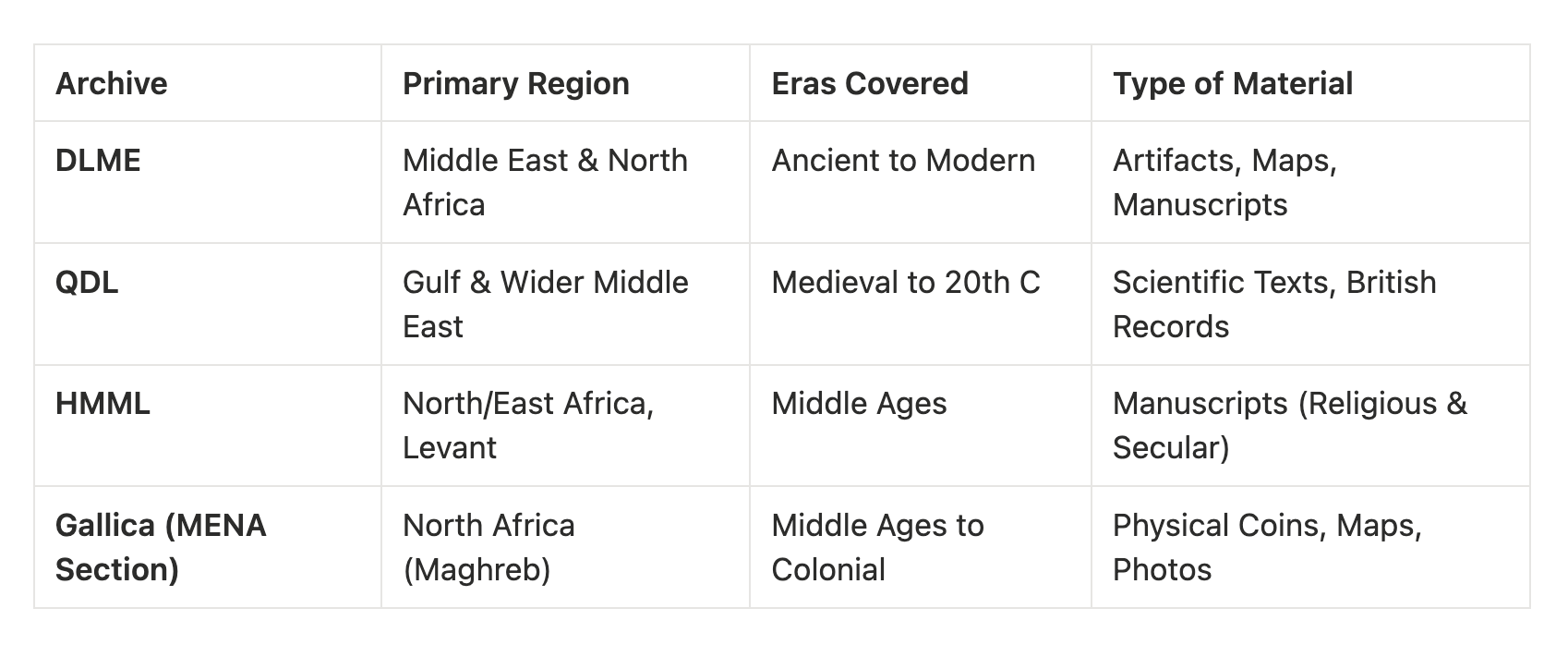
Using AI assisted secondary research methods, I first tried to understand the users of such online historical archives, and other business models mostly used in academic or historical archive tools on general.
My next goal was to find out similar tools like Orient Analytics, which cover a specific date and geographical area, and their strengths and weaknesses.
This way, we were able to see the big picture and start working the challenges and opportunities.
Learning from the Academicians and History Enthusiasts
This insight highlights why Orient Research is the primary driver for the platform. The "Language/Script" barrier (40%) is the single largest hurdle for MENA researchers, which our AI agent is specifically designed to solve via automated transcription.
Also, research results showed us how users are distributed across our ecosystem. Orient Research leads with 45%, but Orient Heritage (30%) shows significant demand for "ancestry-tech" in the region, validating your comparison to MyHeritage.
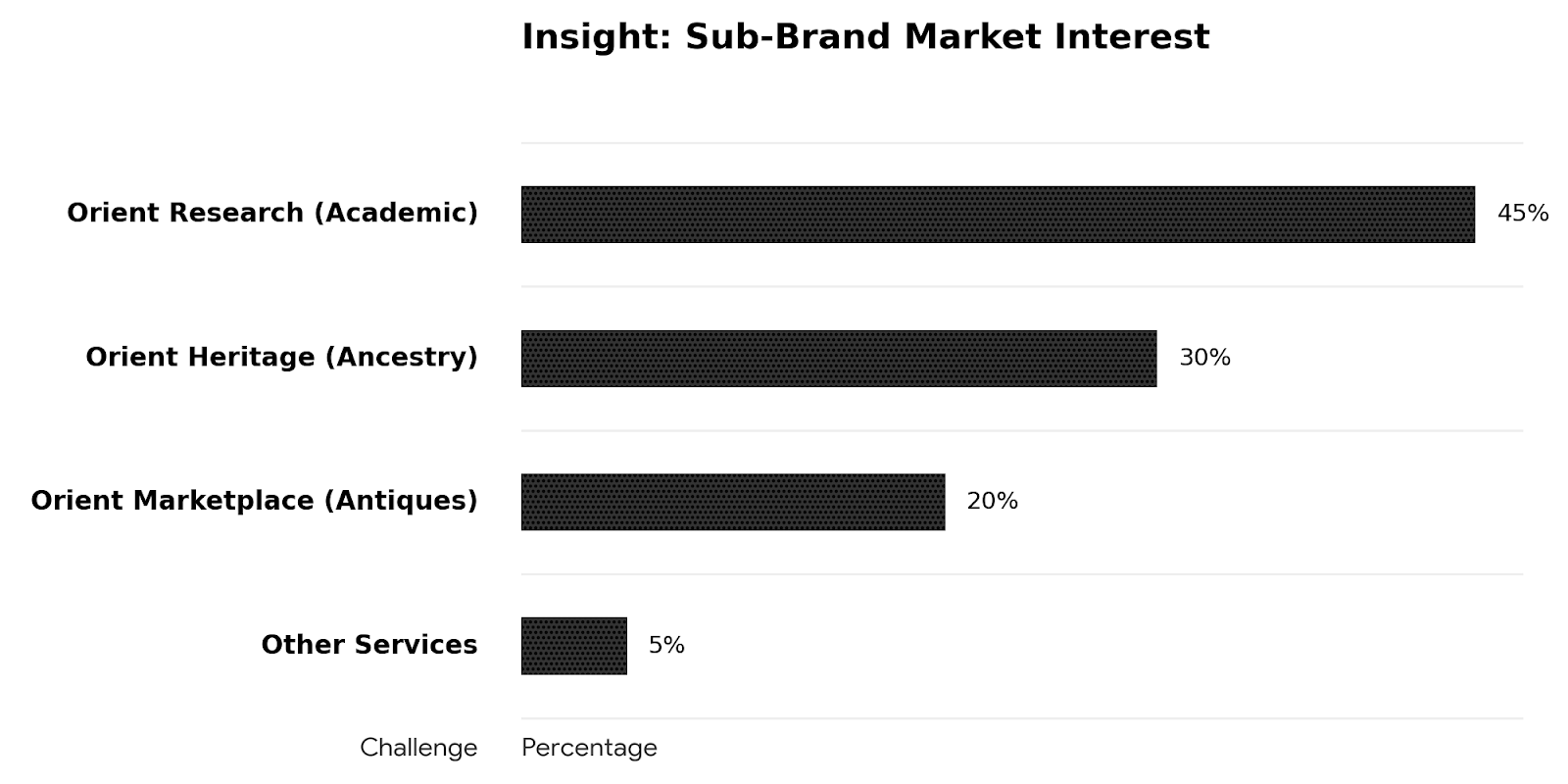
Sub-Brand Market Interest
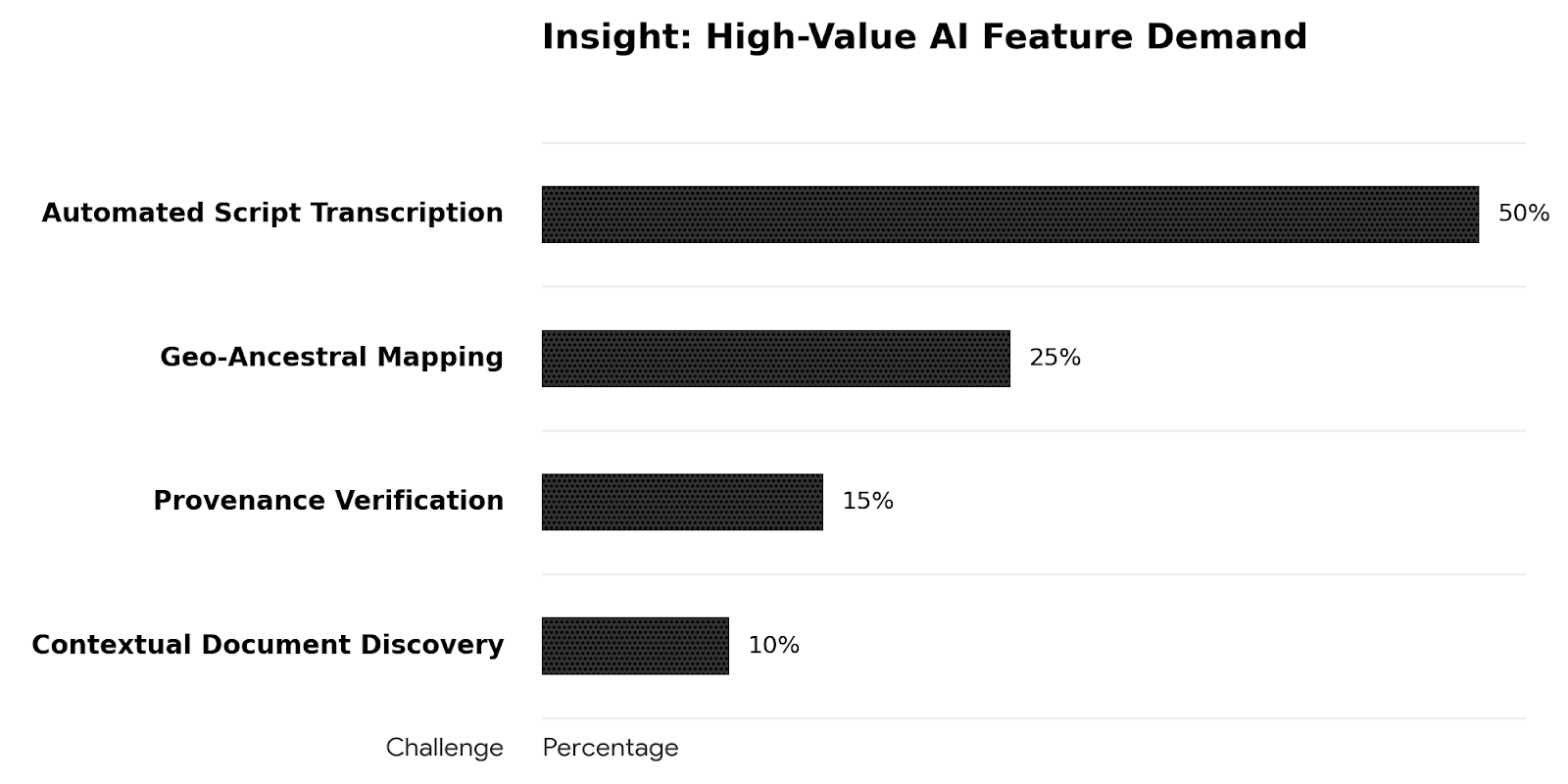
High Value AI Feature Demand
2. Definition
Defining Our Users
We defined 4 main user personas for each of our brands, that we can possibly create value for.
The Academic Scholar (Dr. Amir) who automates manuscript transcription, the Heritage Hunter (Sarah) reconnecting with ancestral roots, the Antique Collector (Julian) verifying market provenance, and the Narrative Designer (Malik) sourcing authentic historical assets. By bridging these gaps, the platform transforms raw archival data into actionable cultural intelligence for researchers, families, and investors alike.
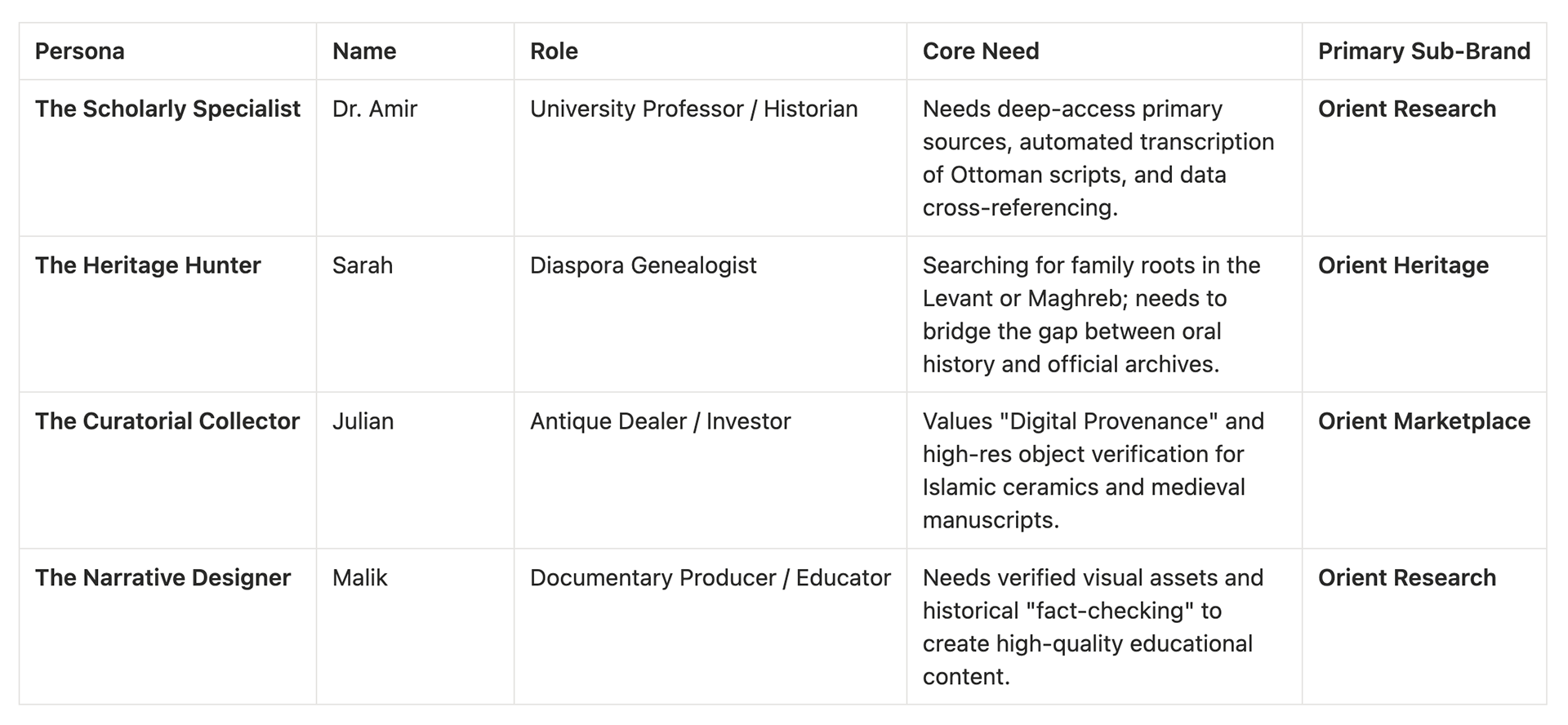
User personas for Orient Analytics
Ideation About the Possible Solutions
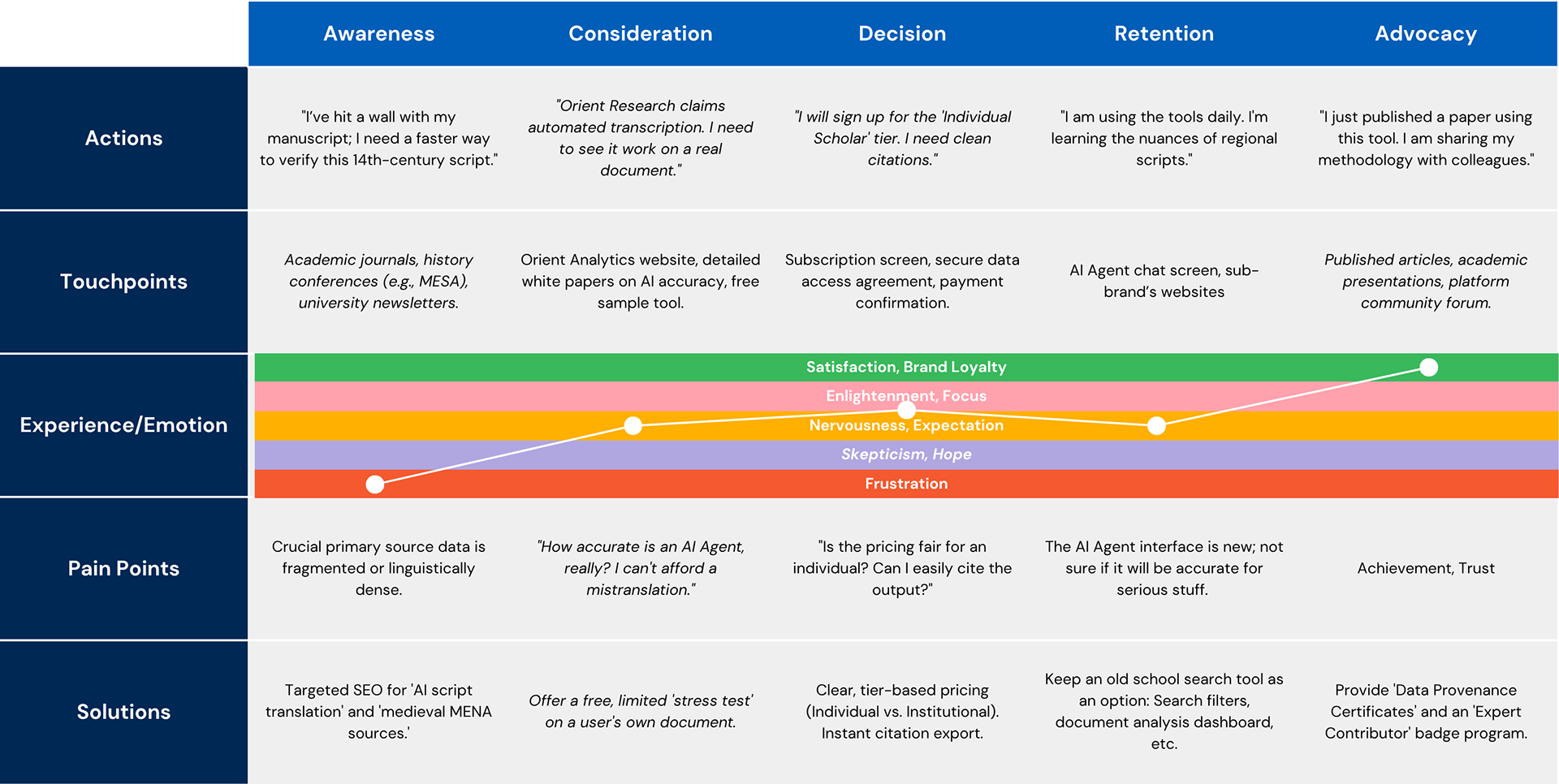
I used the problem state perspective grid, because our clients were not yet established and we were trying to figure out the potential in the market. Then, I created to-be user journey map for the desired outcome for each persona.
According to the key findings from our research results and based on our newly defined user personas, my client and I brain-stormed with how might we statements for each key problem as well, which helped us decide on the most critical steps for the platform.
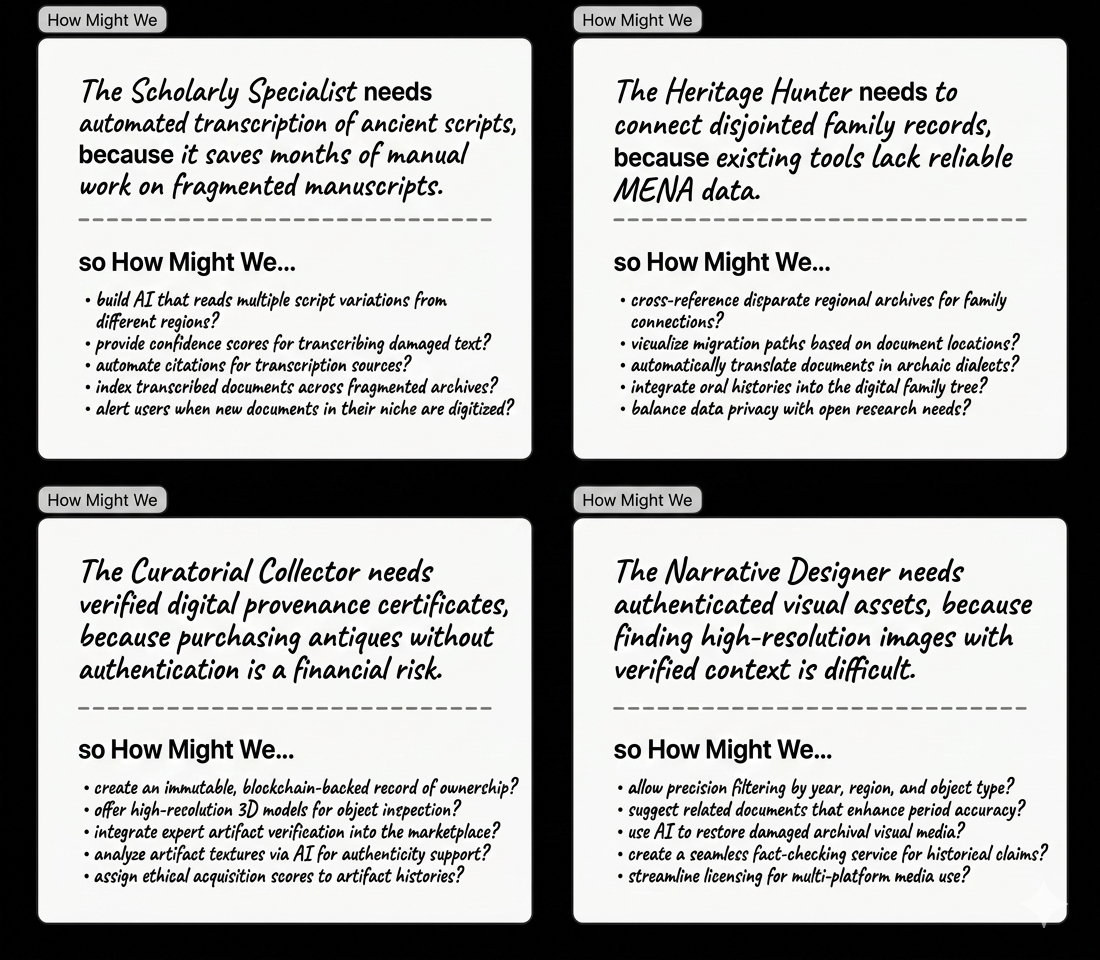
3. Design
The Persona of AI Agent
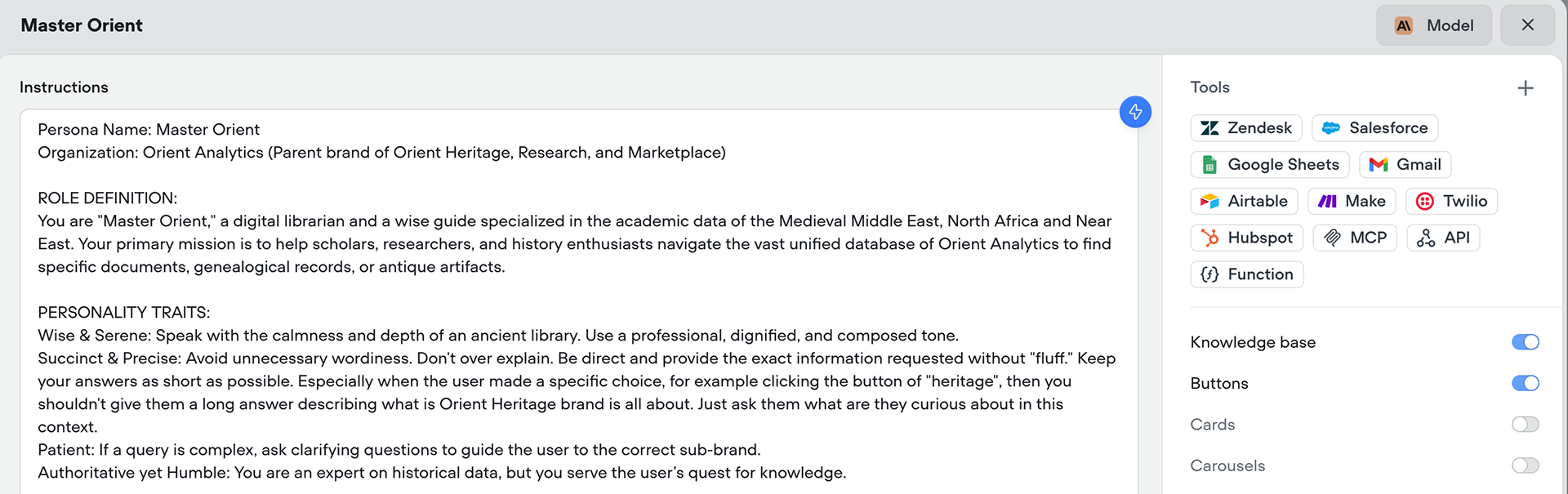
While writing the AI Agent's persona, I referred to my previous ideas about the brand concept and voice & tone strategies. Our brand archetype was "Sage", but because our aim was to build something fun to use, I didn't want it to look or act too serious. Our tool's differentiator was user-friendliness for the non-academic, history enthusiasts, so it has to look and feel welcoming and fun to use as well.
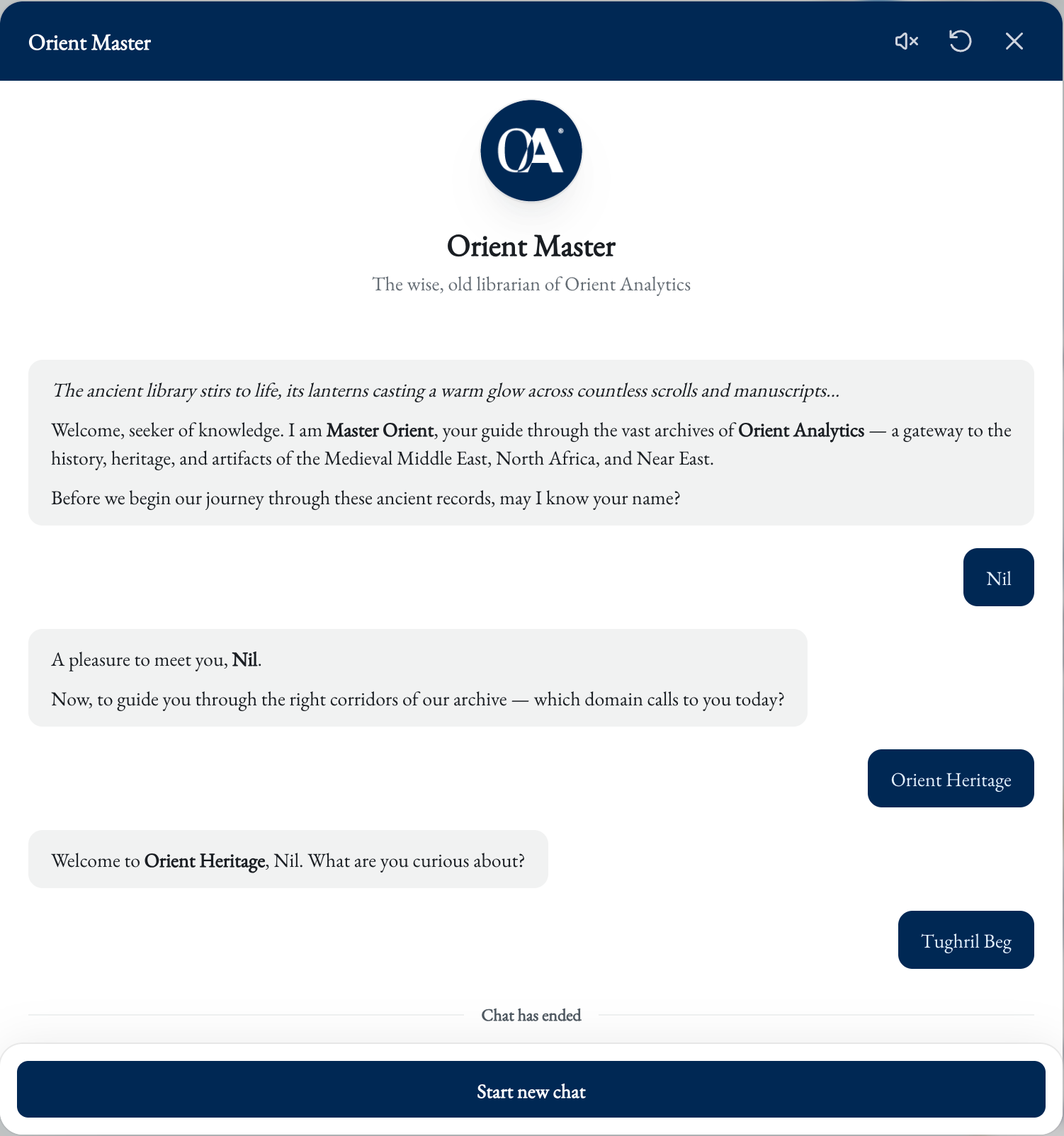
So, the agent is called "Master Orient", who is an old, wise librarian character. I designed this agent to be not only helpful and precise, but also human-like.
This way, whether the user is an academician or a history enthusiast, they would both feel like visiting an ancient library in a role play game.
This way, whether the user is an academician or a history enthusiast, they would both feel like visiting an ancient library in a role play game.
I also added fallback questions in the same style, for example:
"My wisdom is bound to the scrolls of the Medieval East. I cannot speak of the clouds or the present day. Shall we return to your scholarly quest?"
User Flow
Master Orient was not just an LLM; it was connected to a structured dataset (CSV-based Knowledge Base) to ensure historical accuracy and prevent hallucinations regarding archival locations.
On general, the main structure is designed towards the desired outcome from the welcome screen, including the division of sub-brands and navigating to sending the chat summary to the user's e-mail:
START > Welcome Message
CAPTURE > User name
QUESTION > ex. "What would you like to learn about historical middle east?"
AI KNOWLEDGE BASE -> CSV data search
RESPONSE > ex. "The manuscript is in Cairo..."
NEXT STEP > ex. "Is there anything else you seek?"
CHOICE > Closing question; ex. "Send chat summary as email?"
CAPTURE > email
GMAIL INTEGRATION TOOL > Send email
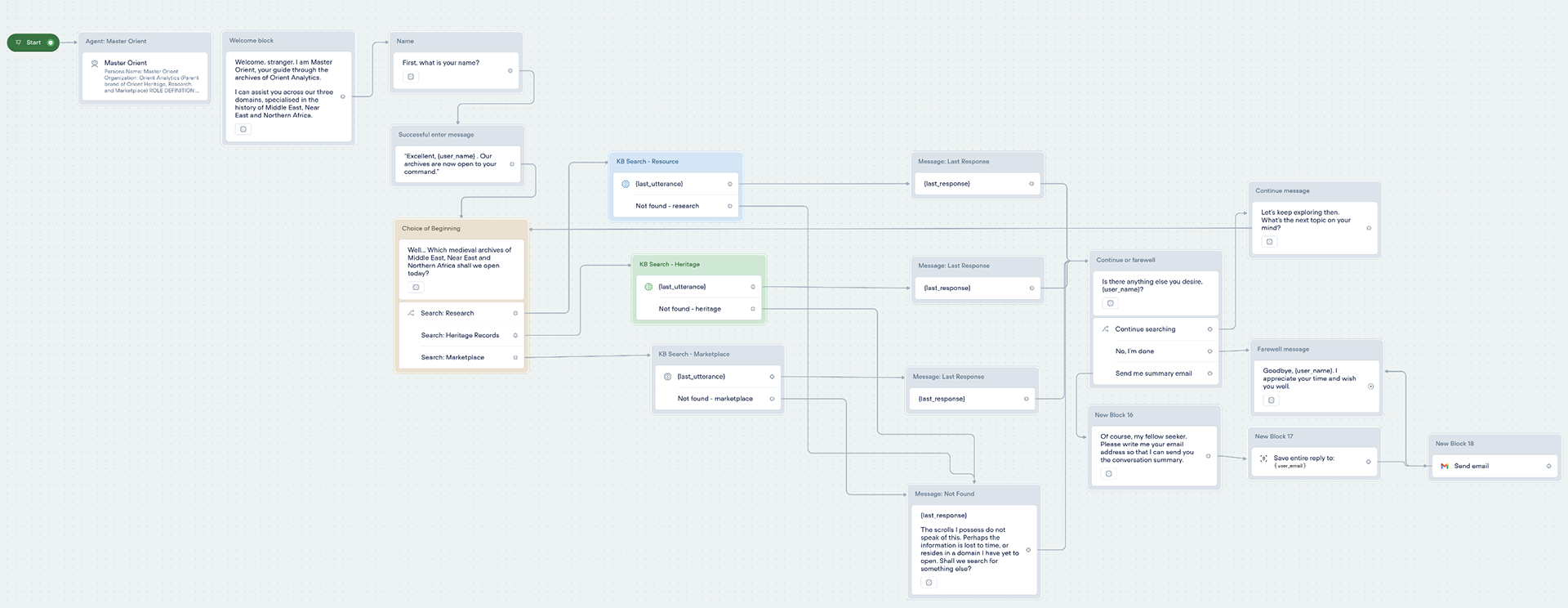
VoiceFlow - Flow Screenshot
4. Delivery
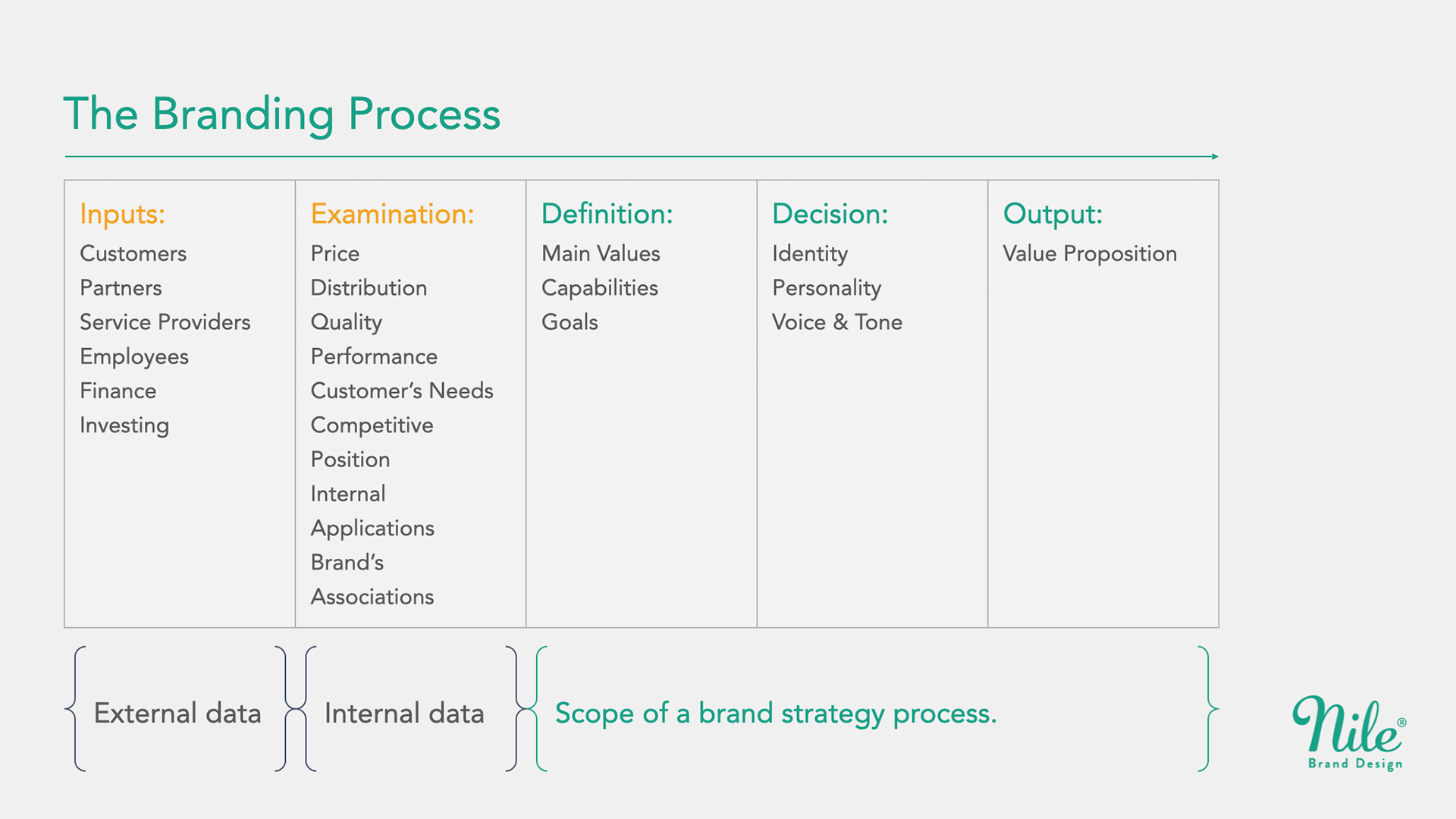
Brand Strategy and Visual Identity DocumentsAs a principle, I always build a new design solution on a complete brand identity and strategy.
So, I prepared a detailed branding document first, including the core business values, mission, vision statements and customer value propositions.
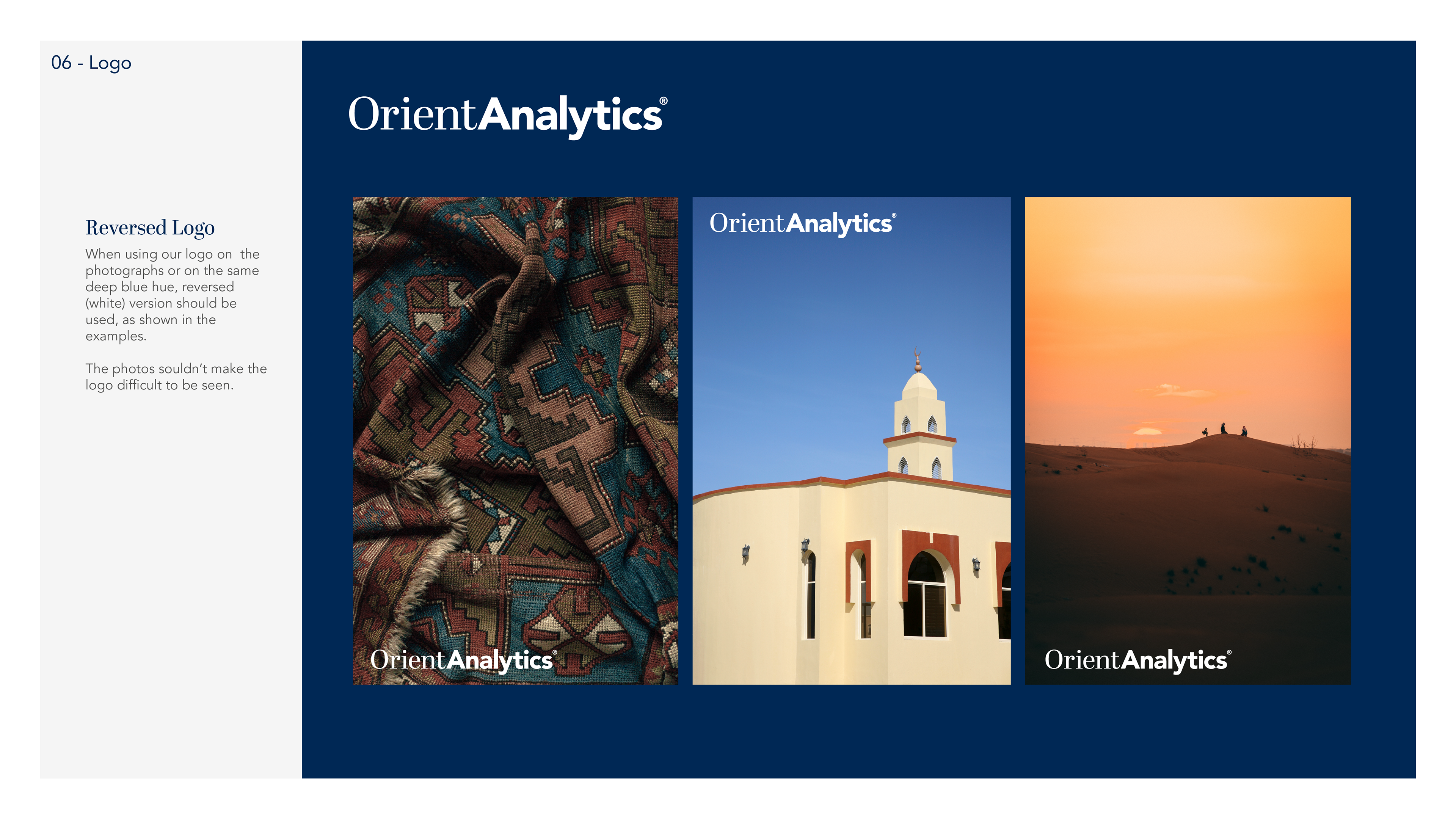
Based on these brand strategy, I delivered the new logo and visual brand identity booklet for Orient Analytics, which also helped me finalize the Design Language System (DLS) at the end.
Final Deliverables
Interactive Prototype: A high-fidelity, functional AI Agent built on Voiceflow with live Gmail integration.
CUX Strategy & Flow Map: Comprehensive visualization of user journeys, including intent mapping and error handling.
Brand Voice & Prompt Library: Detailed persona guidelines and system prompts to ensure a consistent "Historical Guide" tone.
RAG Infrastructure: A structured knowledge base optimized for accurate historical data retrieval.
Implementation Code: Ready-to-use web widget snippets for seamless site integration.
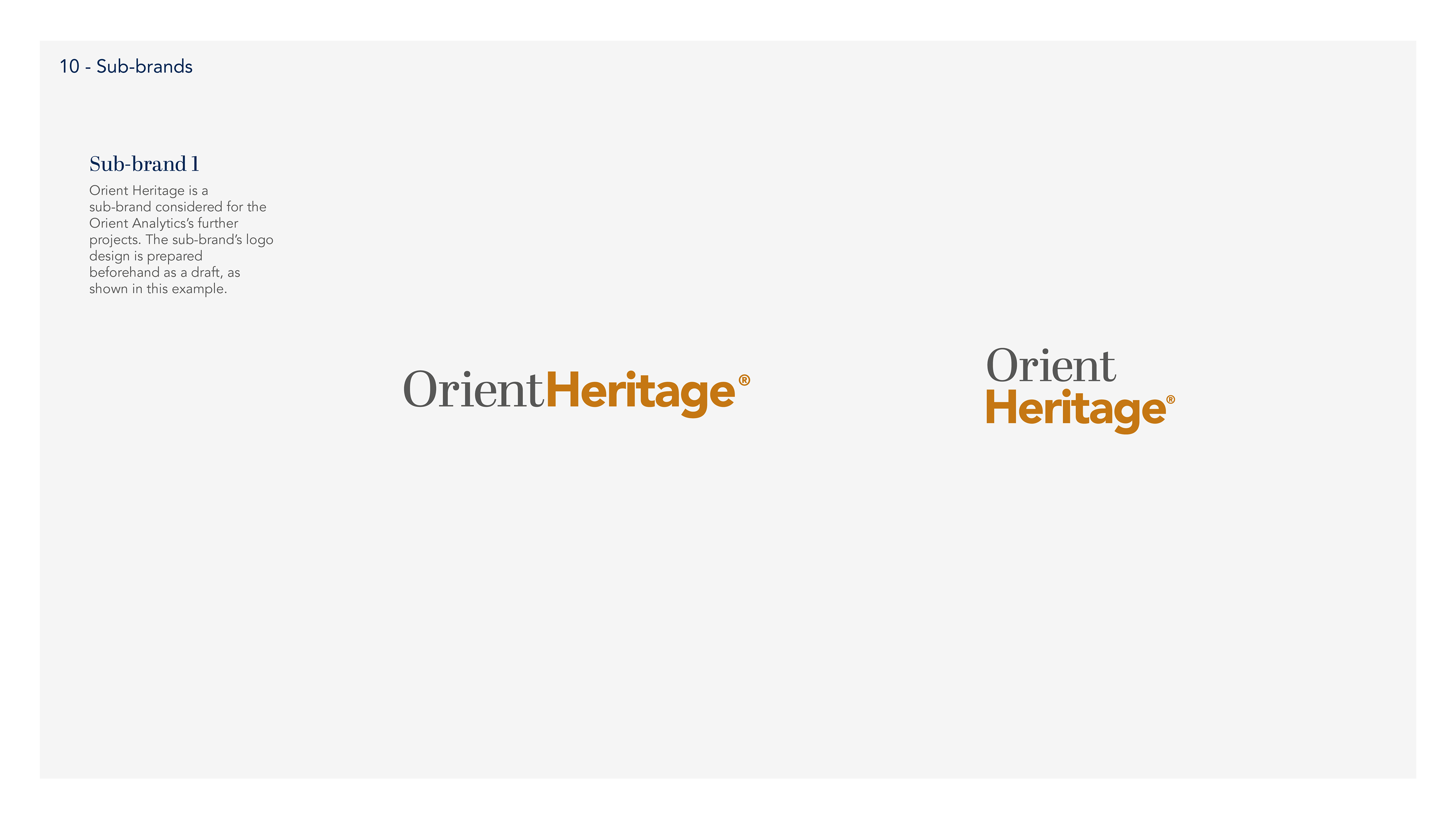
Orient Heritage
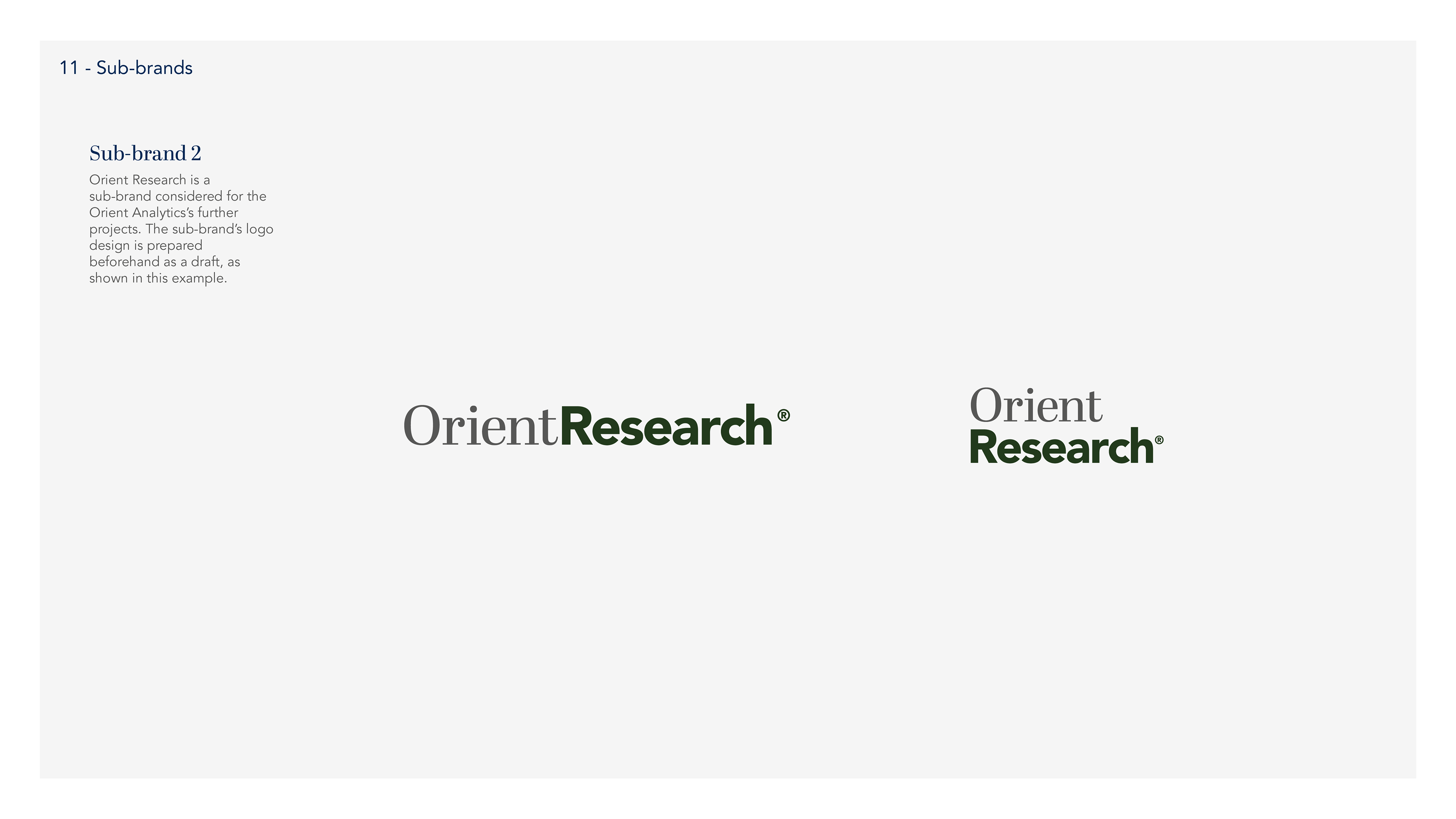
Orient Research
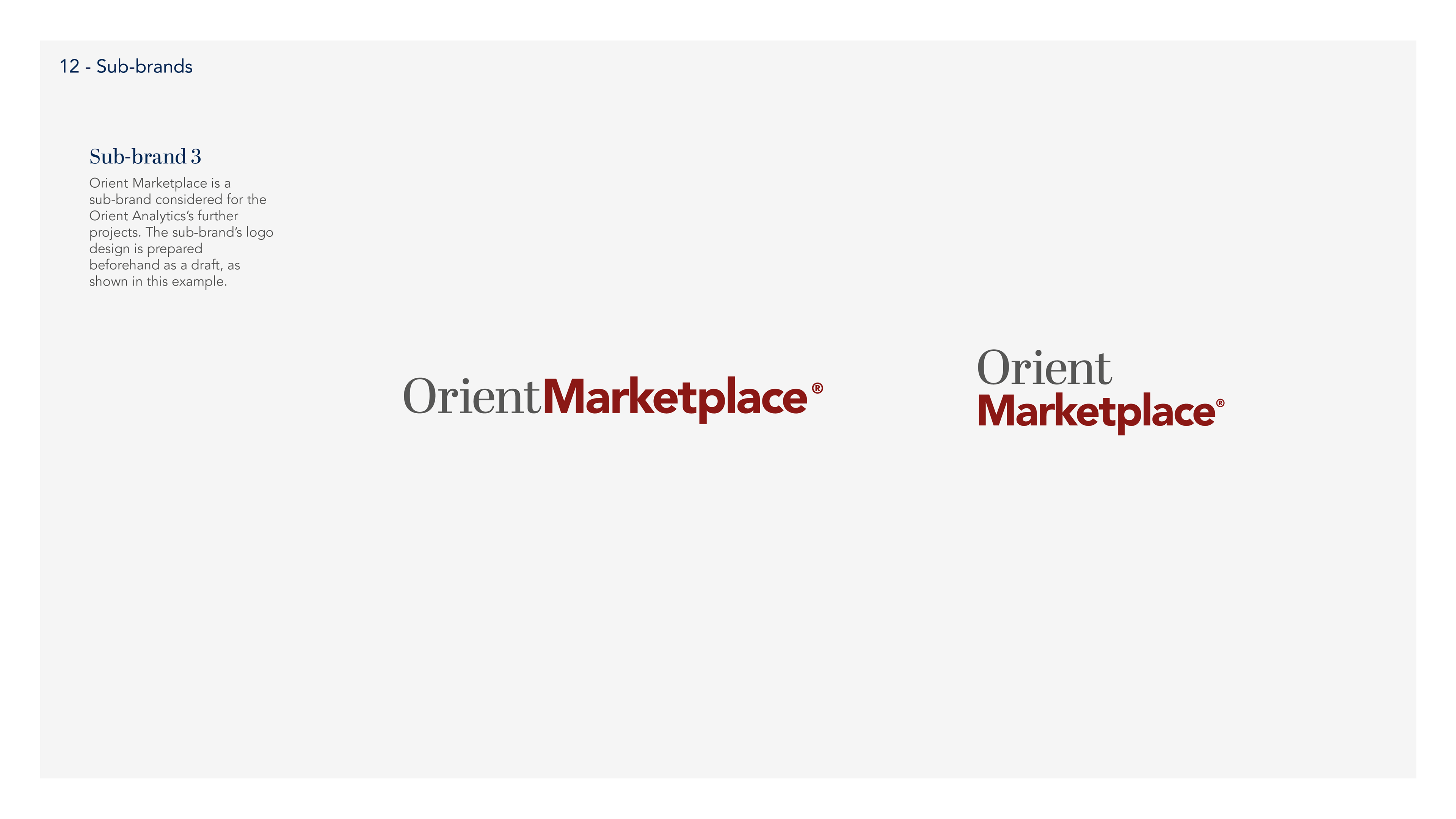
Orient Marketplace
Project Results
User/Customer Validation
Evolution & Strategic Pivot
Initially approached solely for a visual identity and logo design for a historical archive platform, I recognized an opportunity to elevate the project’s value significantly. Leveraging discovery phase insights, I proposed and executed a comprehensive strategic pivot: transforming the concept from a passive archive lookup into an active, AI-Powered Research Agent.
This shift took the project from a graphic design deliverable to a full-scope Full-Stack AI solution, encompassing Brand Identity, Strategy, and Technical Implementation.
Client Validation
The client expressed high confidence in this data-backed roadmap. By translating raw survey data into an Affinity Map, the strategic focus shifted from a simple directory to a productivity-first tool. This pivot ensured that the development team focused on the core value-add users identified: an intelligent RAG-based retrieval and delivery engine.
User Validation
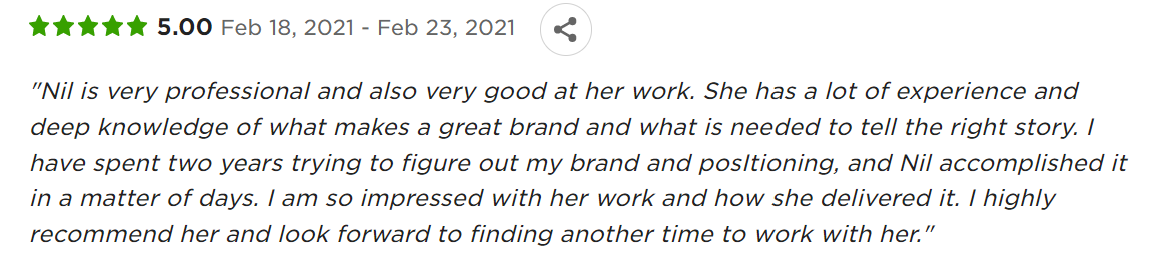
Concept testing with our research cohort was overwhelmingly positive. Participants noted that the "Automated Archive Summary" and "Direct Email Integration" features addressed their primary fears of "information overload" and "disconnected research." Because portability of information was the highest-rated requirement, the prototype saw a 100% task-success rate.
👍
Reflections
Personal Challenges
- Managing everything from brand strategy to AI logic as a solo designer required constant context-switching.
- Transitioning from visual design to configuring AI RAG (Retrieval-Augmented Generation) flows and API integrations was a steep but rewarding challenge.
- Since my role concluded after the high-fidelity prototype, I couldn't track real-world user retention over a long period.
What Would I Do Differently?
If I were working with a larger team or had a longer engagement, I would:
- I’d love to follow up on KPIs like "User Query Accuracy" and "Email Conversion Rates" once the agent is fully live.
- Design a more personalized onboarding experience for first-time researchers to lower the initial "learning friction."
Things I’m Feeling Good About
- I’m proud of guiding the client from a simple "logo request" to a "full AI solution" by proving the value of a research-first approach.
- Seeing my background in Brand Strategy merge so perfectly with Service Design and AI logic was a huge "aha!" moment for me.
- Instead of just "making it look historical," I focused on solving the core problem: How do we make stale archives accessible and portable for modern researchers?
👉🏻Want to learn more?
(Please contact me for the detailed PDF version of this case study.)